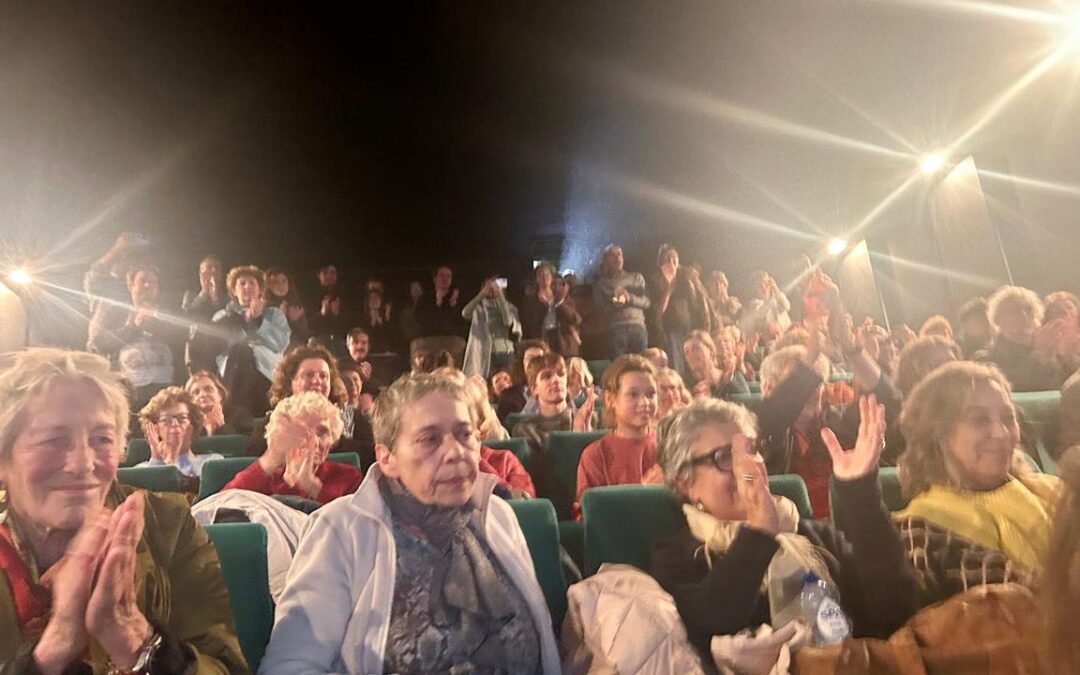
On 8 December 2025 I had the honour and the pleasure of joining friends and admirers of Stelios Kouloglou in Brussels, at the historic Cinema Vendôme, for the avant-première of his new documentary, Naître 2 fois – Born Twice.
The idea was born three years ago, when an article about Simon Gronowski, now 94, caught the attention of the experienced director. During the pandemic, Gronowski would play the piano at the open window of his home in Brussels, offering passers-by a breath of optimism.
His longing for a life that is free and worth fighting for carries special weight once you learn how his story began: a child of a Jewish family, he escaped from the Nazi train taking him and his mother to an extermination camp, thanks to the desperate yet heroic act of his mother, who urged him to jump from the moving wagon.
The title Naître 2 fois is no coincidence. The protagonist has lived by the unshakeable conviction that “my mother did not give birth to me a second time so that I would live unhappily; I owe it to her to be happy.” Time and pain did not imprison him; they shaped him, giving him the strength to resist a tragic fate.
Stelios Kouloglou does not limit himself to telling the harrowing story of a child who survived the Holocaust, nor to repeating the well-known historical facts of the Nazi era. Instead, he turns his gaze to Gronowski’s adult identity, to how his personality was formed and to the way he developed a philosophy of life that transcends trauma.
The documentary also sheds light on his remarkable friendship with Koenraad Tinel, the son of a notorious Belgian Nazi collaborator, bringing to the fore the conflicting memories that weigh on both men: one carrying his family’s guilt, the other the loss of a family tragedy. A friendship in which personal truth transcends the roles of perpetrator and victim.
This remarkable man, a symbol for the people of Belgium, chose not only to open his heart and free from guilt those who carried the legacy of the Nazi past, but also found the strength to forgive people connected with the darkest pages of that era.
The superb footage, alternating between the neighbourhoods of Brussels and an almost dystopian landscape brought to life through Koenraad Tinel’s inspired drawings, creates images in which the frame becomes a narrative in itself. The director’s sensitive eye is matched by the original score of the acclaimed composer Panagiotis Kalantzopoulos.
All this adds up to a cinematic experience that rightly earned warm applause from those of us lucky enough to be there, in the presence of Gronowski and the director, Stelios Kouloglou.
An engaging discussion with the audience followed, from which Stelios Kouloglou wanted to gather ideas and feedback for the final cut of his film. The evening ended with jazz on the piano, played by Gronowski himself together with his band.
The screening was organised by Paul Emile Dupret and Buen Vivir.
“La vie est belle. You must live happily.”
Simon Gronowski
First published on newsville.be